
Forest wandering
If a tree falls and no one is there to hear it…

…or:
When a wheel rolls through the forest, but no one is riding on it, does it make a path?
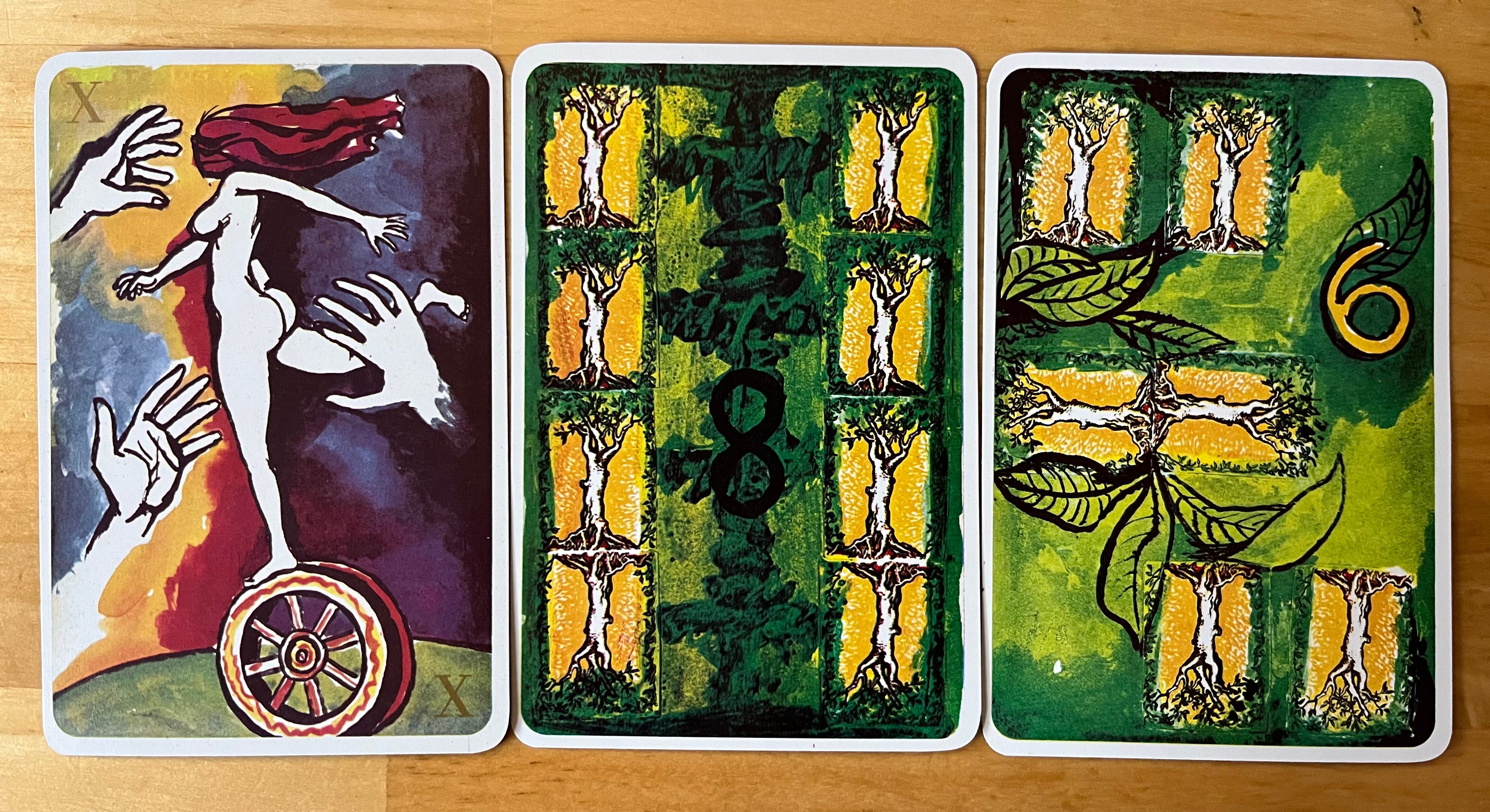
Upon seeing these cards, I’m reminded of a recent conversation I was listening to about the felling of trees. About the loss of specific trees who have been lived with, the loss of trees who are kin. And about how the Earth moves us—emotionally, in our psyches, spiritually, and also physically.
That conversation reminded me of my own falling tree story, and the cards bring this memory back up for me again. A story that feels as much about “chance” or “fortune” as it is about trees. It’s the night of October 29, 2012, and Hurricane Sandy is rolling through the streets of New York City. Or I should say, it’s the following day after the storm has finished passing through.
The bed I’ve been asleep in overnight is directly beneath a window at the back of our building in Carroll Gardens, Brooklyn. I slept through the night fine—my memory is that I even slept very well. Looking out that window from our top-floor apartment before going to bed, I could see an intersection a few blocks away had become a lake, flooded from the rains and overflow from the Superfund-designated Gowanus Canal. (I always used to joke that the mosquitos we had in the summer glowed green with toxic, radioactive light. And I can’t tell you how many mosquito bites I got over the course of my 14 years living in that apartment.)
But when I wake up in the morning, what catches my attention looking through that window is the huge tree in our building’s backyard. A huge tree that, at some point during the night, had split at the base of the trunk and fallen in the opposite direction from the building—instead of having crashed through the bedroom window. A very scary near miss. Perhaps not a matter of “chance,” but definitely one of “fortune.” For me at least, as the tree did cause damage to a fence and garage in the lot behind ours.
Sortilege is divination by the casting of lots, (ex. card reading). There’s a way in which I might even think of that tree as having divined whose lot in life would be affected. Or perhaps the storm had engaged in divination by tree.
I sit writing now in another apartment entirely, and think about my current backyard, our plot of dirt in which almost nothing grows, partly because it is so heavily shaded by trees. Our first summer here, we tried to grow vegetables, but just not enough sunlight gets through.
But the other thing that comes up for me with these cards and all this tree-talk has to do with ancestry and identity. The woman in the first card seems to ride the wheel back into the past, as if to escape from grabbing hands. And then I read the following:
Have you ever stopped to think about how many things had to go right in order for you to be sitting here reading these words? How much had to go wrong? How many ancestors had to narrowly avoid death, had to find each other across famines and floods, wander across wars and wastelands? How many tragedies and missteps had to place them at specific points in space and time, a map of possibilities? Is there any order to the madness that made you?1
Going 13 generations back equals around 8,000 ancestors. 8,000 different people who were necessary over all that time, in order for me to happen. And another 8,000 people for you to come to be. The number of different individual ancestors who are all within me is staggering to think about. (This is not even to mention the number of other-than-human ancestors who came before our human ancestors; or the number of your future ancestors, should you have children, who then have children who then have children…)
Some time ago, I became interested in my genealogy as part of developing my ancestor veneration practice. But I quickly came to realize that there’s only so far back I can go in the family tree of my father’s side. In my father’s father’s line, I can really only trace three generations back, and beyond that everything becomes completely opaque.
You see, my great-grandfather fled from the equally murky, somewhat uncategorizable land of Prussia/Germany/Poland/Russia in 1920 (I believe, based on my research) in order to escape the pogroms. He was able to get out by taking the last name of a dead person. Even having a vague (and unconfirmed) idea of what my “real” last name might have been, it becomes very difficult to find information and records from that particular swath of land from that particular time period. For very obvious reasons. This is also not something that I recall ever being talked about when I was younger.
There is, in a sense, a large opening cut through my knowledge of who and where I come from. Which interestingly might have something to do with why my Ashkenazi heritage, and why Judaism more broadly, has never been something I’m particularly interested in or attached to. (And at some points in my life, I have been specifically resistant to any interest in it. I recall my Bar Mitzvah being a particularly awful and anxiety-producing event—I was incredibly shy and sensitive as a young boy, and having to stand up before a room full of people and sing a torah portion, before my voice had changed, probably had impacts on me beyond what I’m aware of.)
But more and more what I’ve come to realize, is that grasping backwards into the past for more certainty about this aspect of my identity isn’t necessary. Trying to find all of that out doesn’t necessarily contribute to meaning-making. My identity is much more shaped by the absence. It’s this absence that is actually what’s present in me. Not so much a haunting, but a generative loss that’s made me who I am, at least in part.
We place so much emphasis on knowing things, figuring them out, finding out how things have come to be. What of all the absences and losses we may not even be aware of? How many other paths cut by fallen trees, near misses, absences and losses, how much other missing material, might be more generative of who I am than the stuff that is known and present? The absences that might be even more present and enlivening than some of the presences? More generative than even the stuff that can be known?
The open path through the forest and the regularity and constancy of the rolling wheel brings me to my breath. How the air that gives us life, the act of breathing, can only occur in reciprocity with the breathing of the trees around us. That biological interdependence is happening whether you think about it, deny it, have other concepts about it... a co-creative process that affirms selfhood through dissolving selfhood.2 Like our ancestors, the breathing of the trees is our breathing.
Willow Defebaugh, “Chaos Theory,” from The Overview, Atmos weekly newsletter, Feb 23, 2024: https://atmos.earth/overview-chaos-theory/
From my notes on Andreas Weber’s presentation “The Paradox of the Individual—A Biopoetic Perspective,” part of Kinship: An Exploration into Being Together, Advaya, April 5, 2022; https://advaya.co/events/2022/03/15/kinship-online-course.
w/ your excerpted quote, i was wondering if it was nora's quote partly because of a line i heard from her yesterday, "the outrageous mathematics of life" which has really stuck with me. but then i saw it's by willow defebaugh from the overview and yes, that's another writer/explorer i appreciate and read.
i appreciated your points that absences and what doesn't happen shape us probably way more than we're aware of. and another line by someone (tuesday ryan-hart/rivera) has been knocking around in my mind: "the breaking is the making."