
Traces, essences, angels...
And fragments of readings on control

I keep thinking I see him… As I came down the hallway, I ever so briefly mistook the abstract, semi-floral pattern on the bag in the bathroom shower stall for his face, as though he was in there using his litter box.1 The bag that holds cans and cans of his prescription wet food, still waiting to be donated to the vet’s office over a month later.
I was pouring myself a Negroni for cocktail hour and accidentally spilled some gin on the floor, and it’s hard to know which thought came first or if somehow they were simultaneous: the thought of how I always used to be concerned about spilled alcohol when Mr. B was around / the thought of the spilled alcohol as almost like an “angel’s share” ...and now he is with the angels (in a matter of speaking). The spilled spirits now a libation for his spirit, instead of something that might fatally poison him.
His absence still feels so palpable. It’s fascinating, wondrous, mysterious how a lack of material presence can create such a profoundly physical affect.
I’m thinking about the traces left, the way previous movements and actions leave ghost-like trails… and, since spirits have shown up here as I write, the question of essences, how the idea of something being “essential” and the related idea of “authenticity” trouble me.
The tendency [is] to think of authenticity as the thing that remains when the top layers of surface tensions have peeled away—and the inauthentic as the failure to represent this essence. The essence of a person. There are risks in thinking this way… Instead of being a pathological deviation from some representational truth or core or identity, the inauthentic is the richness of the relational… Authenticity needs to be seen as a performative co-creation of possibilities, instead of being correspondence with an unchanging internal truth.2
From the perspective that we live in a universe of purely material “things,” that the living world functions as if machinery, it’s easy to reduce everything to try and find the specific part without which they cease to be what they “truly” are. But in that kind of purely materialist worldview (which it should be obvious I do not embrace), even death is no ending, providing the rich fecundity of decay for other life to continue and/or emerge. (Though, I think perhaps death may be the one and only essential of life.) And if we consider all the “dead” pieces of technology and machinery lying about in our landfills, it seems pretty clear that they continue to live on in other ways too, by leaching heavy metals into the soil and groundwaters, for example.
As I think about essence, what is essential, I’m brought back to thoughts in my last post about control. The reduction to something essential, by definition, means the exclusion of other stuff. And whoever is performing that essentializing is doing so through their particular frames of experience and context. And yet the idea of authenticity or essence is so often considered to be something of a more profound level than subjective perception/opinion.
I have a difficult time with the idea that the ability to peel things down to an “authentic essence” is even possible from a personal/subjective standpoint, given how entangled our “individual” perceptions are with the world around us. Not to mention that what we are conscious of at any given moment is limited. Which brings me back to the issue of control…
On what principles does your mind select that which ‘you’ will be aware of? While not much is known of these principles…the principles at work are often not themselves accessible to consciousness. First of all, much of the input is consciously scanned, but only after it has been processed by the totally unconscious process of perception. The sensory events are packaged into images and these images are then ‘conscious.’
I, the conscious I, see an unconsciously edited version of a small percentage of what affects my retina. I am guided in my perception by purposes. …It is a short-cut device to enable you to get quickly at what you want.3
Wandering back to thinking about the traces we leave, how the ghosts of past decisions continue to haunt us… I know that when I made the decision to have Mr. B euthanized, it was the right thing to do to prevent him from suffering a drawn out death by, essentially, starvation. And yet, I am also still plagued now and then by a feeling that’s not quite guilt or second guessing—but something close to that. He was showing all the signs of an impending death (in addition to not eating or drinking, withdrawing to atypical, out of the way places in the apartment, for example), and yet it was I who decided to end his life preemptively. Even if only minimally so.
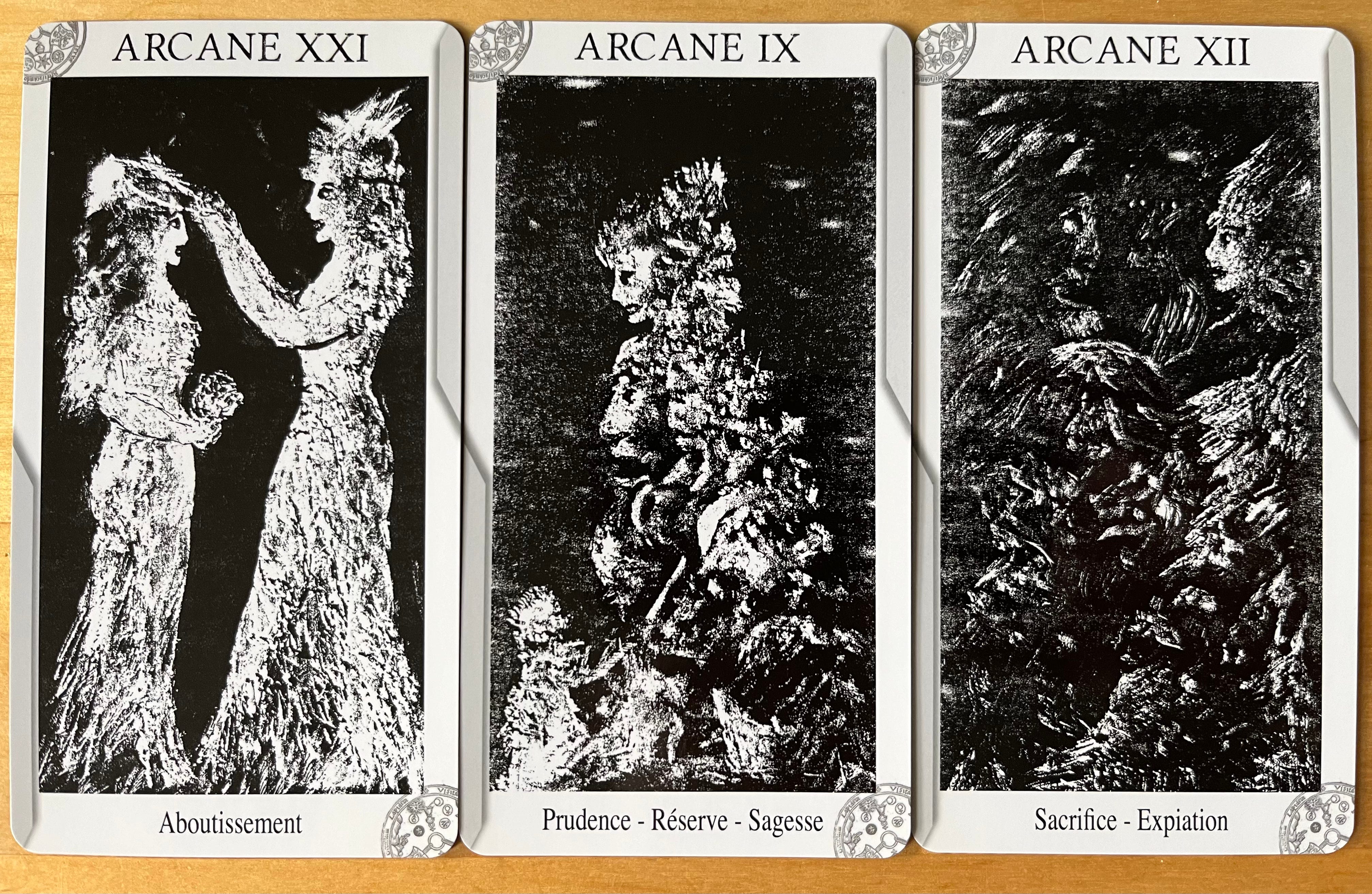
Moving from left to right here, I love how the mark-making seems to become less and less clear, less obvious, less heavy-handed. The most human-seeming of the figures becoming less and less so. What might be the outcome for our world if we had the wisdom to sacrifice conscious purpose?
Today the purposes of consciousness are implemented by more and more effective [technology], machinery, transportation systems, airplanes, weaponry, medicine, pesticides, and so forth. Conscious purpose is now empowered to upset the balances of the body, of society, and of the biological world around us. A pathology—a loss of balance—is threatened.4
If an organism or aggregate of organisms sets to work with a focus on its own survival and thinks that that is the way to select its adaptive moves, its ‘progress’ ends up with a destroyed environment. If the organism ends up destroying its environment, it has in fact destroyed itself.5
How can we lighten the marks and traces we leave behind? Can we begin to think more like how the rest of nature works and less like humans?6 We are of course wedded to the effects of centuries worth of heavy mark-making on the world, but would that sacrifice of control be enough to atone? Is it even possible? Or as the figures in the cards above gradually fade into the darkness, is the human species already doomed to extinction, and it’s just a matter of time?
Odd as this sounds out of context, we are strangely and atypically blessed with having two full bathrooms in our NYC apartment, and so Mr. B had one bathroom almost exclusively to himself. His litter boxes used to sit on the floor of the shower stall.
Bayo Akomolafe, commenting on “The Trouble with Authenticity”
Gregory Bateson (1968), “Conscious Purpose versus Nature,” in Steps to an Ecology of Mind. University of Chicago Press, 2000 edition; pp. 438–439.
Ibid. p. 440.
Gregory Bateson (1970), “Form, Substance, and Difference,” in Steps to an Ecology of Mind. University of Chicago Press, 2000 edition; p. 455.
“The major problems in the world are the result of the difference between how nature works and the way people think.” —a statement attributed to Gregory Bateson.